A Cost‑Effective Alternative to DAA and RF Overlay
Cable operators in North America increasingly need to address fiber‑based MDUs. Rural programs, acquired fiber networks and greenfield projects are just some of the reasons why there are now many buildings where broadband is delivered over PON or point‑to‑point fiber, and coax still reaches the TVs.
In those buildings, the broadband story is clear. The TV story often isn’t.
On the HFC side of the footprint, it is straightforward to deliver broadband and broadcast: DAA and Remote PHY, or a traditional CMTS and QAM channels. In fiber MDUs, the choices are much less attractive: no traditional broadcast at all, RF overlay you would rather not keep alive, or RPD deployment that makes little sense if the building already runs fully on fiber.
This is exactly where a skinny TV approach, fed over IP into the MDU and turned into broadcast on coax, becomes the most cost‑effective and least labor‑intensive option. While fiber inside the MDU can be point‑to‑point, a typical fiber MDU today is PON‑based, and you’ll see one of three patterns.
First, the broadband‑only, apps‑only model. Fiber brings IP to the building; ONTs or gateways deliver data to units; residents are told to use their own streaming apps and OTT services. Architecturally, this is clean. Commercially, it has gaps. It makes it hard to offer a simple skinny broadcast bundle or bulk TV deal for the property. It pushes all responsibility for “TV that just works” onto residents and property managers. In buildings where many residents are broadcast natives, it quietly weakens the operator’s position.
Second, PON with RF overlay. The video wavelength and EDFAs may still exist for historical reasons: a legacy analog/digital overlay that predates the move to IP video. Keeping it going just to provide a handful of linear channels has obvious costs. You need overlay‑capable optics, extra components in the field, and a shrinking pool of technicians who are comfortable troubleshooting EDFA issues and RF levels. ONTs with RF outputs are more expensive and less flexible than simple data ONTs.
Third, the theoretical “just put an RPD there” idea. In some cases, there is pressure to put a Remote PHY Device in the MDU because that is how the rest of the HFC network handles broadband and broadcast. For a building already running broadband on PON, this becomes an awkward hybrid: DOCSIS infrastructure added purely to regenerate QAM, while broadband is already delivered over PON. The capital and operational overhead of DAA – CCAP resources, RPD hardware, powering, DOCSIS tools – is hard to justify if the only new service in that building is a skinny TV bundle.
None of these paths is satisfying if you believe there is still business value in offering cost‑effective basic broadcast into PON‑served MDUs.
A different pattern is to accept PON (or point‑to‑point fiber) as the way IP reaches the building and treat broadcast as a light edge function, not as a reason to revive heavy video infrastructure. In this model, the video channels are IP streams like everything else. They travel over your existing IP transport into the MDU’s telecom room, where an edge device turns that IP lineup into digital broadcast channels and feeds them into the coax that already runs to apartments. This is a delivery method for specific fiber MDUs – not a new TV service category.
The building still sees you as the broadband and TV provider. The coax is still used for basic TV channels. But you do not need RF overlay in the access network, and you do not need to deploy RPDs purely for broadcast in MDUs.
For a cable operator, this approach has several practical advantages.
- It keeps PON simple. You can buy and deploy the cheapest, cleanest PON CPE without RF overlay requirements. The access network only needs to deliver IP.
- It reuses coax in a way that aligns with how MDUs are actually wired. In most brownfield MDUs, coax is the one thing you can assume will be in every unit. Even in many newer buildings with Cat5e/6, coax is still pulled to main TV locations. Using that coax for a slim broadcast lineup gives you something you cannot get from a pure apps‑only model: TV that appears on any set after a channel scan, with no in‑unit devices.
- It keeps the broadcast footprint intentionally small. Instead of rebuilding a full pay‑TV bundle, you define an MDU‑specific skinny lineup – local channels and a few national anchors – and deliver it as IP multicast into the building. The edge device maps those streams to QAM.
- It is easier to justify financially. Compared with putting RPDs into PON MDUs, a compact IP‑to‑RF edge platform is a simpler bill of materials: one device in the telecom room, no DOCSIS, no new DAA ecosystem for that building. Compared with RF overlay, you remove EDFAs and specialized optics from the long‑haul path and consolidate complexity into a small, replaceable box at the edge.
Operationally, it stays inside your IP and broadcast toolchains. Seen this way, “skinny TV for PON MDUs” is not about going backwards to legacy video. It is about giving cable operators a realistic option in buildings where PON already exists and where heavy DAA or RF overlay would be overkill – while still having a credible broadcast story wherever coax is present and broadcast still matters.
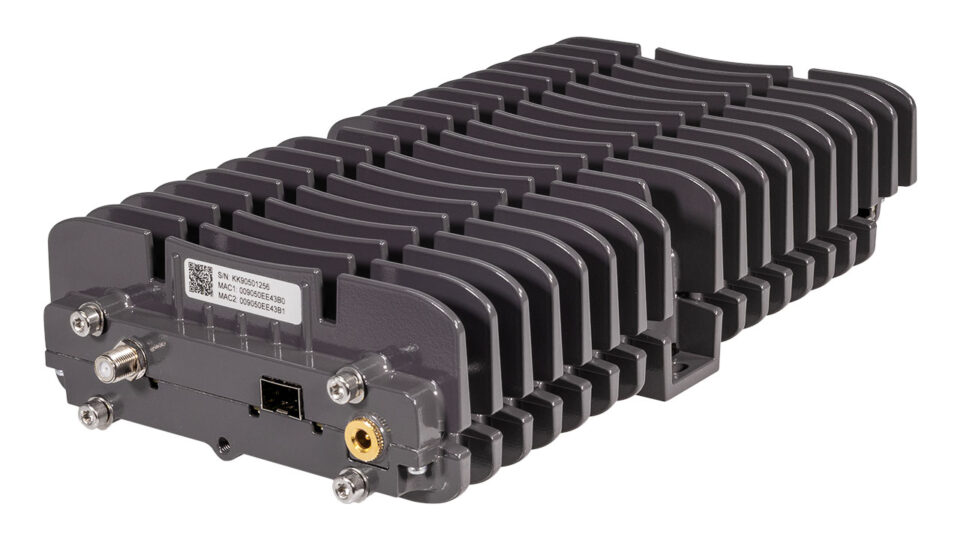
Learn more about Luminato X32
Teleste Luminato X32 is a compact, high-performance Edge QAM platform that simplifies TV signal distribution across modern networks. It integrates natively with PON architectures, supports RF overlay replacement, and enables efficient, cost-effective broadcast TV delivery.