Sustainability Is No Longer a Feature. It Is a Design Principle.
Why the technologies that create lasting value help people focus on what matters most
The technology industry is entering a paradox
Never before have we had access to so much computing power, data, and intelligence. Yet organizations still face a familiar challenge: how do we apply these capabilities to solve the problems that truly matter?
As Artificial Intelligence accelerates digital transformation, a new reality is emerging. Computing resources are not unlimited. The growing demand for processors, memory, storage, energy, and data center capacity reminds us that every technological decision consumes resources and should contribute to a meaningful outcome.
This idea extends far beyond AI. Every system we build relies on resources, whether they are energy, infrastructure, materials, expertise, time, or human attention. Seen through this lens, sustainability becomes more than an environmental discussion. It becomes a question of how we create the greatest benefit from the resources available to us.
In public transportation, this challenge is particularly visible. Operators are expected to manage increasingly complex networks while delivering reliable passenger information, efficient operations, and better travel experiences. As systems become more capable, ensuring that effort and investment are directed where they have the greatest impact becomes increasingly important.
The Most Valuable Resource
The most valuable resource in any transportation organization is not technology. It is the people who use it.
Every day, operators, planners, maintenance teams, and control room personnel make thousands of decisions. Yet modern systems often generate more information than anyone can realistically process. Instead of reducing complexity, technology can sometimes transfer it to the user rather than remove it.
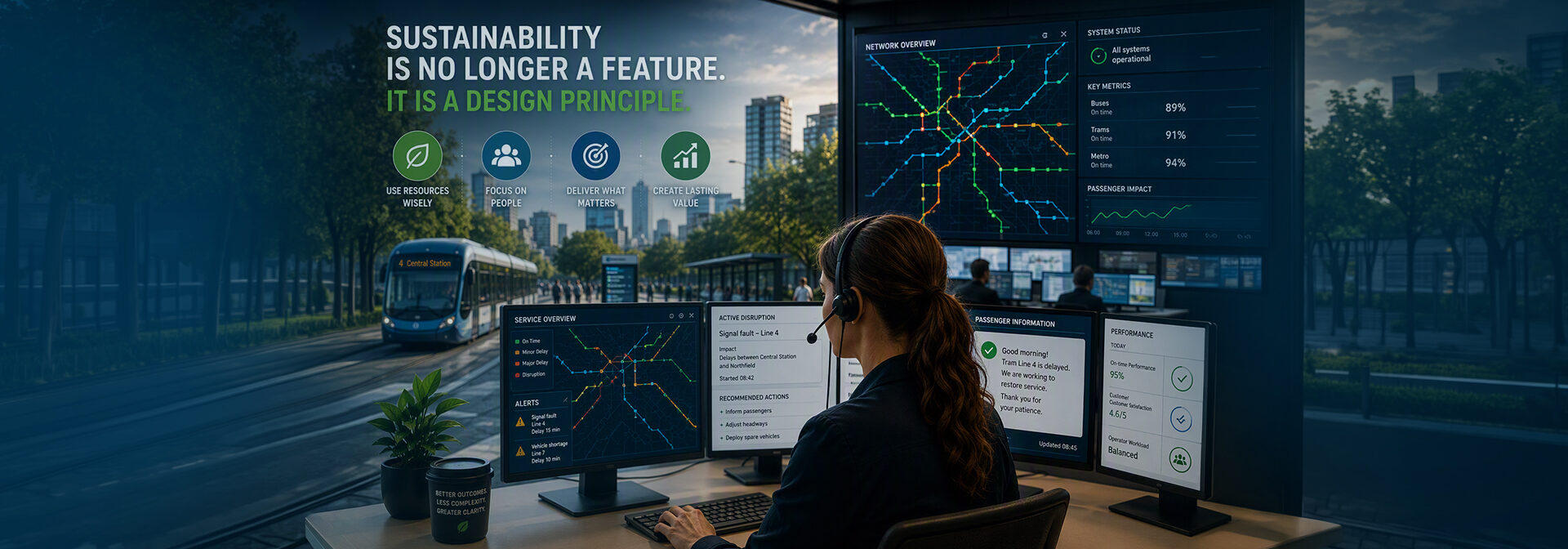
Consider a control room operator managing a service disruption during peak hours. Information arrives from multiple sources: vehicle systems, operational updates, passenger information systems, and field personnel. The challenge is rarely a lack of data. More often, it is identifying what matters most at a specific moment.
The same lesson applies to AI. Generating answers is not the same as creating value. Organizations that gain the most from AI will not necessarily be those producing the largest volume of outputs. They will be the ones using intelligence to identify the most relevant problems, support better decisions, and focus attention where it matters most.
Accurate passenger information provides a practical example. When travelers receive timely updates, operators can spend less time handling routine inquiries and more time resolving disruptions. The benefit comes from delivering the right information to the right people at the right time.
Human-Centered Design Creates Better Outcomes
Resource stewardship and human-centered design ultimately pursue the same objective: helping people achieve better outcomes with less effort and less complexity.
Technology should be evaluated not only by performance, but by the results it enables. The most effective systems:
- Reduce complexity
- Remove friction
- Simplify decisions
- Help people focus on what matters most
The goal is not to maximize the amount of information available. It is to maximize its usefulness by delivering relevant information in the right context and at the right moment.
In transportation networks, information creates impact only when it helps passengers make decisions and enables operators to respond effectively. Technology should reduce uncertainty, not add to it.
Designing the Future of Mobility
Digitalization in public transportation will continue to accelerate. More sensors. More connectivity. More displays. More automation. More intelligence.
The question is not whether we can build these systems. The question is whether we can design them responsibly.
Future mobility infrastructure should direct resources where they matter most: improving outcomes for passengers, operators, and transport authorities. Every watt consumed, every processor cycle, every byte stored, every action requested from an operator, and every piece of passenger information delivered should contribute to a better decision, a smoother journey, or a more effective operation.
For many years, the technology industry optimized for performance. The next decade will require something different: optimization for value. The organizations that lead the future will not necessarily be those with the most powerful systems. They will be the ones that help people achieve better outcomes with less complexity and greater clarity.
Technology should not compete for human attention. It should help people focus on what matters most.
That is the direction innovation should take.
And perhaps the most human one.


Claudio Borrello
Claudio Borrello
I am heading Display Solutions business unit at Teleste, furthering new business development efforts that respond to the dynamic needs of the public transport sector. See my LinkedIn.